Every other spec on a custom wall calendar follows from one decision you make first: the size. The trim size sets how far away the calendar reads, how much room people have to write on a given day, which binding options are even available, and how much it costs to print and ship. Get it right and the calendar earns its spot on the wall for twelve months. Get it wrong and it either disappears into a busy office or overwhelms a small kitchen. Here is how the common formats compare, and how to match one to the wall it will hang on.
The standard sizes and what each one is for
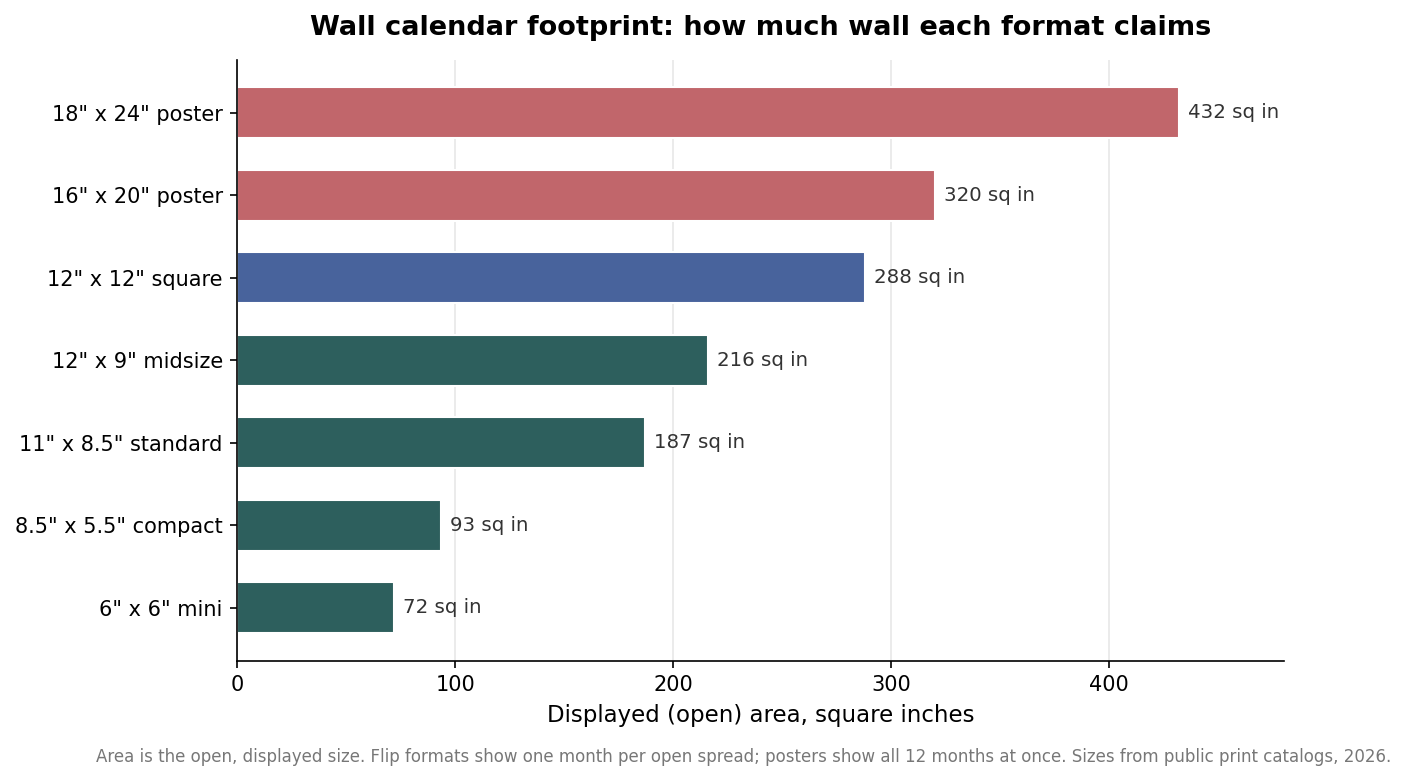
The most common wall calendar is an 11″ by 8.5″ flip that opens to 11″ by 17″. It reads cleanly from three to six feet away, which covers most homes, hallways, and shared offices, and it is the format buyers picture by default. Below it sits a compact 8.5″ by 5.5″ flip that opens to 8.5″ by 11″, meant for tight walls and cubicles where a full-size calendar would crowd the space. Above it, a 12″ by 9″ flip opening to 12″ by 18″ buys noticeably more writing room in each day block without jumping to a poster footprint, which makes it the quiet favorite for households and teams that actually schedule on the calendar rather than just glance at it.
From there the formats specialize. A 12″ by 12″ square that opens to 12″ by 24″ gives the largest single-month visibility of the flip formats and frames square, social-media-style photography beautifully, so it suits classrooms, conference rooms, and photo-driven brands. Portrait layouts such as an 8.5″ by 11″ page opening to 8.5″ by 22″ exist for vertical imagery, and mini options down to 6″ by 6″ cover very tight spaces or bundled gifts. Match the size to the room first and the artwork second; a gorgeous 12″ square is wasted on a narrow galley kitchen, and a mini calendar is invisible in a warehouse.
Flip formats versus poster calendars
A flip calendar and a poster calendar solve two different problems. The flip formats above show one month per open spread, so they stay compact on the wall and give each month generous space, but you only ever see the current month. Poster calendars, typically 16″ by 20″ or 18″ by 24″, print all twelve months on a single sheet. That trades per-day writing room for whole-year visibility, which is exactly what a project team, a production floor, or a family coordinating a school year wants when everyone needs to see months at a glance. The rule of thumb: choose a flip when the calendar is primarily a monthly planner and a poster when it is primarily a planning-the-year reference. Posters also change your shipping math, since they usually travel flat or rolled rather than folded into a standard mailer.
How size drives paper, binding, and cost
Size quietly constrains the rest of the build. A popular and reliable stock combination is an 80-lb gloss cover with 100-lb gloss text pages, heavy enough to hang flat and resist curling through a humid summer without feeling flimsy. Binding then depends partly on page count and format. Saddle stitching, where sheets are folded and stapled at the center, is the most economical route and works well for compact flip calendars, but it requires the total page count to be divisible by four and starts at a minimum of about eight pages. Spiral or coil binding threads a plastic coil through punched holes, lays completely flat, and holds up to a full year of daily flipping, which is why it is the workhorse for standard and larger wall calendars. Wire-O binding uses a rigid double-loop wire for a more polished, corporate look at a higher price. All three can lay flat; the practical differences are cost and how premium the finished piece feels in the hand.
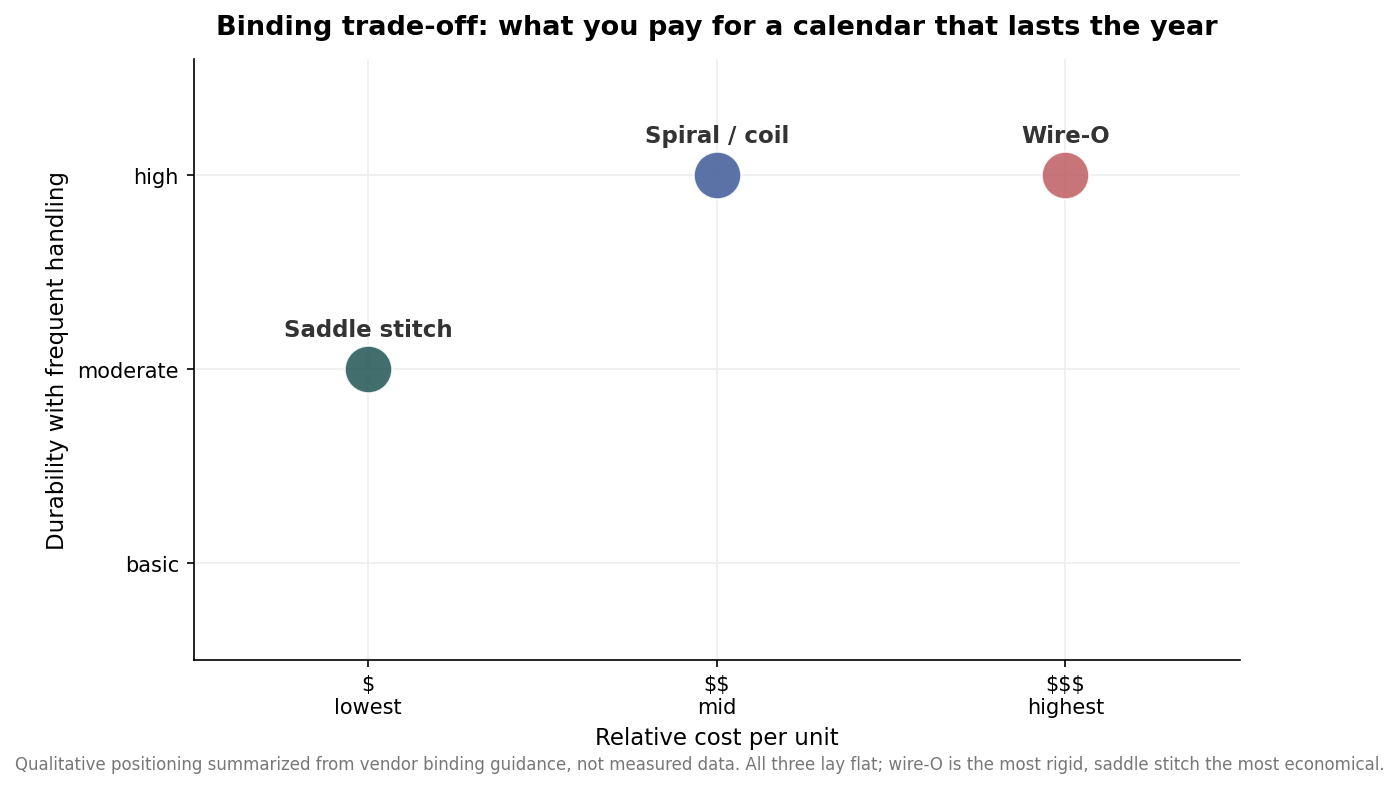
Cost scales with the obvious levers, mostly area and page count. A larger trim size uses more paper per leaf, a heavier stock costs more per sheet, and an upgraded binding adds a per-unit charge. None of these are large on their own, but they stack, so a 12″ square on premium stock with wire-O binding can cost several times what a compact saddle-stitched flip costs at the same quantity. If budget is the constraint, hold the size sensible and spend on the stock and binding that the calendar’s audience will actually notice.
Reading distance and writing room, the two specs buyers forget
Before you sign off on a size, walk the two use cases that decide satisfaction. The first is reading distance: stand where the calendar will be seen from most often and ask whether the date numerals and any branding are legible from there. A standard 11″ by 17″ open size is comfortable at roughly three to six feet; a mini format needs you within arm’s reach, and a poster is built to be read across a room. The second is writing room. If people will hand-write appointments, birthdays, or shift notes, the day blocks on a compact calendar fill up fast, and the jump to a 12″ by 18″ or 12″ by 24″ open size is the difference between a usable planner and a decorative one. These two checks take a minute and prevent the most common regret, which is a calendar that looks right in the proof and turns out too small in the room.
Matching the format to your audience and channel
The last filter is where the calendar lives and how it gets there. A customer-gift calendar that ships in the mail favors a standard flip that folds into a protective mailer and survives transit cheaply. A reception-area or classroom calendar can go larger because it stays put and is seen by many people from a distance. A dealer or franchise program that wants one recognizable format across dozens of locations is usually best served by the standard 11″ by 8.5″ flip, which balances cost, legibility, and shipping better than any other single size. Start from the room and the delivery channel, confirm reading distance and writing room, then let paper and binding follow. Do it in that order and the size decision, which drives everything else, is the one you are least likely to second-guess in February.